Supply chains are becoming more complex due to supplier disruptions, rising logistics costs, fragmented ERP systems, and growing customer expectations. Most enterprises already have the data they need across SOPs, shipment records, procurement systems, emails, and warehouse platforms. The challenge is accessing and using that information efficiently.
This is where Retrieval-Augmented Generation (RAG) is transforming supply chain operations.
RAG enables AI systems to retrieve real-time enterprise knowledge before generating responses, making AI more accurate, contextual, and operationally useful than traditional chatbots.
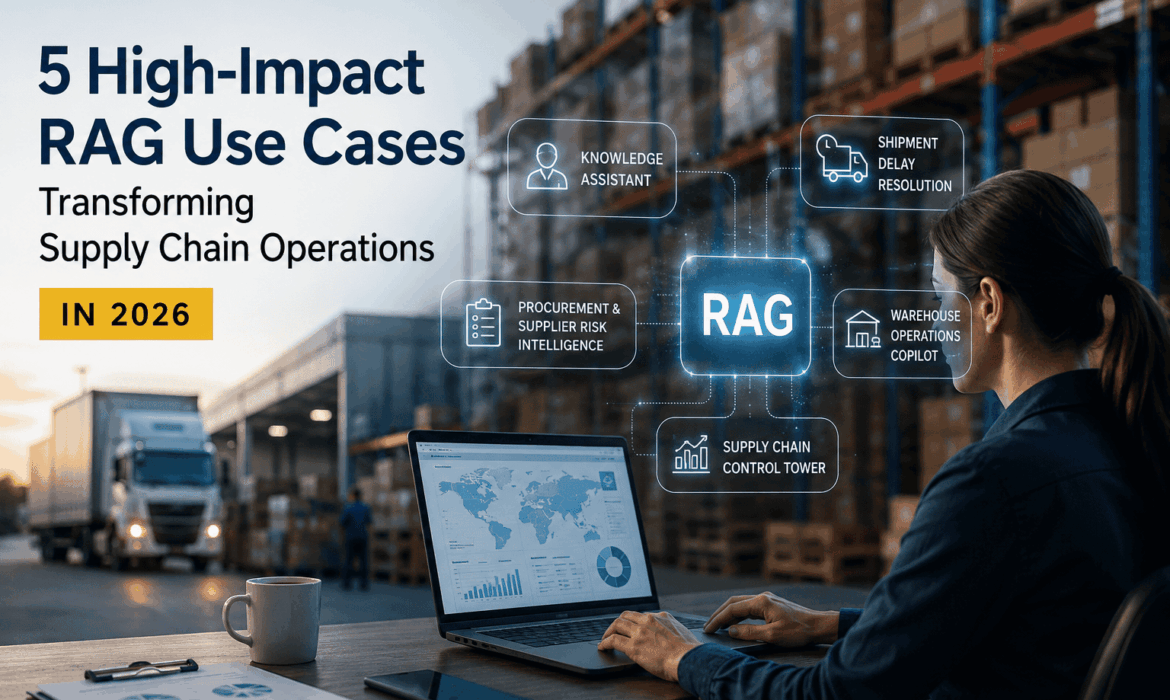
1. AI-Powered Supply Chain Knowledge Assistants
Supply chain teams spend significant time searching across SOPs, emails, and internal systems for operational answers.
RAG-powered assistants allow employees to ask:
“What is the process for delayed shipments?”
“Which carriers support refrigerated freight?”
“What documents are needed for customs clearance?”
The AI retrieves answers from enterprise systems instantly, improving productivity and reducing operational delays.
2. Intelligent Shipment Delay Resolution
RAG systems combine shipment history, carrier updates, weather feeds, and operational data to help teams identify disruptions faster.
For example:
“Why are shipments delayed in Chicago this week?”
The AI can retrieve:
Weather disruptions
Carrier shortages
Port congestion
Customs delays
It can also recommend alternative routing or escalation actions, helping organizations move from reactive to proactive operations.
3. Procurement and Supplier Risk Intelligence
Procurement teams often manage supplier data across multiple disconnected systems.
RAG systems help unify:
Contracts
Vendor scorecards
Compliance records
Supplier communications
Teams can quickly identify:
High-risk suppliers
Contract expiration risks
Alternative vendors
Historical delivery issues
This improves supplier visibility and supports faster decision-making.
4. Warehouse Operations Copilots
Warehouse teams frequently deal with inventory mismatches, training gaps, and manual troubleshooting.
RAG-powered copilots provide real-time operational guidance by retrieving information from:
Warehouse systems
SOPs
Training manuals
Operational knowledge bases
Employees can quickly resolve issues and follow standardized operational procedures, reducing errors and improving efficiency.
5. AI-Powered Supply Chain Control Towers
Modern supply chain leaders need visibility across procurement, transportation, warehousing, and fulfillment operations.
RAG-powered control towers create a conversational intelligence layer across enterprise systems.
Executives can ask:
“Which regions face the highest disruption risk?”
“What inventory shortages are expected next month?”
“Which suppliers are impacting delivery performance?”
Instead of static dashboards, organizations gain real-time operational intelligence and faster decision-making capabilities.
Final Thoughts
Traditional chatbots often fail because they lack access to real-time enterprise knowledge. RAG changes this by grounding AI responses in operational systems and business data.
The future of supply chain AI is not just chat interfaces. It is the combination of:
RAG systems
AI agents
Workflow automation
ERP integrations
Operational intelligence
Organizations adopting enterprise RAG solutions in 2026 will improve operational efficiency, reduce disruptions, and make faster business decisions.
At CloudTern Solutions, we help enterprises build AI-powered RAG systems, AI agents, and workflow automation solutions for logistics, healthcare, insurance, and staffing industries.
We use cookies to ensure that we give you the best experience on our website. If you continue to use this site we will assume that you are happy with it.